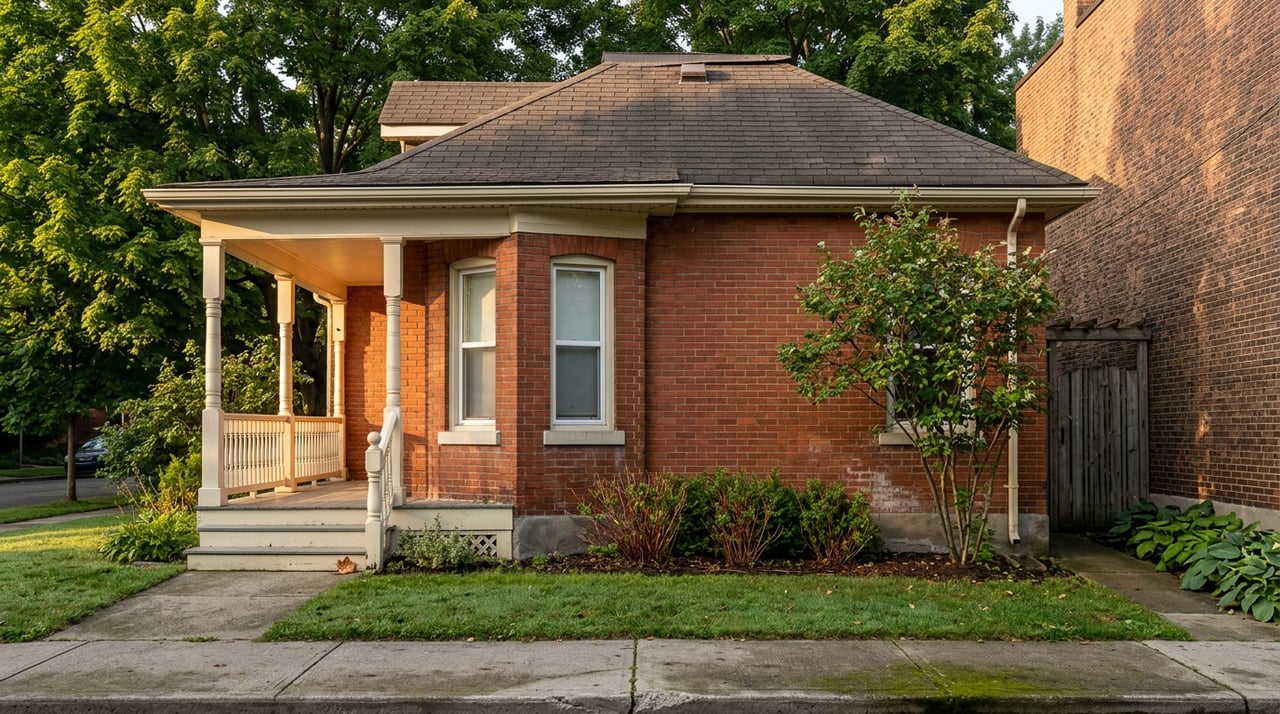
Most Roncesvalles sellers still think of the home inspection as the moment a deal gets renegotiated. In 2026 it is more often the moment a deal gets cancelled, and the reason is not the inspection report itself.
It is the underwriter reading it three days later.
If your Roncy house was built before 1950 (like almost every house in Roncy), there is a chain reaction sitting inside your walls that has quietly become the single most common cause of firm offers collapsing on west-end century homes. The inspector finds knob-and-tube. The buyer calls their insurance broker. The broker calls back with a no. The mortgage cannot fund without bound coverage. The buyer walks, keeps their deposit conditional, and your listing goes back to the board with a story attached to it.
The thesis of this post is simple. In today's Roncesvalles market, the seller who prepares for the buyer's insurance file, not just the inspection, is the seller who closes.
The chain reaction most sellers don't see
A generation ago, knob-and-tube was a negotiation item. A buyer would flag it, ask for a credit, and both sides would meet somewhere in the middle. That era is over.
By 2026 the major Canadian insurers' positions on K&T are roughly as follows: Aviva, Intact, TD Insurance, Wawanesa, and Belair Direct refuse to bind coverage on any home with energized K&T. New policies require an ESA Certificate of Inspection confirming all K&T has been removed. A few carriers will still bridge a buyer, Square One Insurance among them, with a surcharge in the $800 to $2,000 per year range and a visible-K&T inspection requirement, but that is a one-year runway, not a permanent solution.
The forcing function has moved. Most homeowners with K&T can no longer find mainstream coverage, and the insurance market itself is now the reason people rewire.
For a seller, the practical translation is this. When your listing agent tells the buyer's agent that the wiring is "mostly updated with some original in the attic," you have not disclosed a maintenance item. You have disclosed a condition that, for roughly seven in ten mainstream Canadian insurers, is a hard stop.
What actually shows up on a Roncesvalles pre-listing report
Pre-listing inspections are now standard practice on Roncy houses, and for good reason. The reports rhyme from one century home to the next. Here is the pattern an experienced west-end inspector expects to see before they open the front door:
Knob-and-tube in partial runs. Roncesvalles is on the short list of Toronto neighbourhoods where K&T is still present in tens of thousands of homes, an electrical system that was standard from the 1880s through the 1940s. Nearly every home in Toronto's west end was originally built with knob-and-tube, and if an inspector finds some old wiring, more is almost certainly hiding behind the walls.
Federal Pioneer Stab-Lok panels. These must be replaced regardless of capacity, and insurers and the ESA both flag them.
Vermiculite in the attic. Zonolite-brand vermiculite, dominant until 1990, was often asbestos-contaminated, and disturbing it releases asbestos fibres. On a pre-listing report this usually reads as a recommendation to test before any electrical or insulation work proceeds.
Galvanized or lead supply lines. Lead was used in built-up Toronto until WWII, and the City runs an active Lead Pipe Replacement Program. Kitec plumbing, installed 1995 to 2007 with an aluminum core between PEX layers and brass fittings, is also a common west-end finding and is generally recommended for replacement during a renovation.
Wet basements. The number one issue in Toronto's older detached housing, and 90% of it is surface water, not groundwater. That distinction matters when you decide what to fix versus what to disclose and grade around.
Orphaned venting. The residue of a high-efficiency furnace swap that left a water heater alone on an oversized chimney, with condensation and acid attack issues that follow.
None of these findings is unusual. What is unusual is a Roncesvalles house that has none of them. The question is not whether your inspection will flag issues. The question is which of them will trigger a call to an underwriter.
The number that reframes the decision
For a two-storey Roncy semi, a full rewire in 2026 runs $8,000 to $15,000, including a panel upgrade, new wiring throughout, grounded outlets, AFCI and GFCI protection, and ESA inspection. Larger or more complex homes can push into the $20,000 to $30,000 range.
Here is the interpreted number sellers rarely see:
Homes without a completed rewire sell at a 5 to 12 per cent discount versus comparable rewired homes, with longer days-on-market and frequent buyer financing failures, since most major lenders require insurance and most insurers require the ESA Certificate.
On a Roncesvalles semi priced around $1.4 million, a five to twelve per cent discount is $70,000 to $168,000. The rewire budget is a rounding error against that discount. That math is the single most important thing to understand before you list.
The one trap in the middle of that math is partial work. Some Toronto electricians offer partial K&T removal, visible basement circuits only, leaving hidden K&T in walls and attics intact for $4,000 to $8,000. This is a false economy. ESA inspections do not certify partial removal, and insurers do not reinstate coverage on partial removal. If you are going to spend on wiring before listing, spend once and get the ESA Certificate.
Remediate, disclose, or price for it
Not every century-home finding needs to be fixed before listing. The decision tree looks like this:
- Fix before listing when the finding blocks financing. Energized knob-and-tube, a Stab-Lok panel, and any active safety hazard belong in this bucket. Without an ESA Certificate the buyer's mortgage may not close, and no amount of price adjustment solves that.
- Fix before listing when the buyer pool shrinks without it. A cracked clay drain or an obvious wet-basement stain narrows your buyer pool to renovators and investors. That is a smaller pool paying investor prices.
- Disclose and price for it when the fix is elective. Original single-pane windows, an unfinished basement with low ceilings, cast-iron radiators without central air. Retrofitting central air in a home built without ducts usually means choosing between high-velocity systems, ductless mini-splits, or a full forced-air install during a major renovation. These are buyer preferences, not deal-breakers.
- Test, do not disturb, when the finding is asbestos-related. Vermiculite in a sealed attic and asbestos pipe wrap in an unfinished basement are generally inert if left alone. The seller's job is to document, not to abate.
The mistake is treating every red flag on a pre-listing report the same way. Some of them are financing-contingent. Most of them are pricing-contingent. Sellers who conflate the two either overspend on cosmetic remediation or under-spend on the one thing that would have kept the deal together.
Why the June 2026 market makes this decision sharper
The temptation on a rising market is to skip the pre-listing work and let a hot bidding war paper over the inspection. That temptation is stronger today than it has been in a year.
In June 2026 the GTA housing market continued to improve, with sales growing strongly year-over-year while new listings declined, and first-half 2026 sales have edged higher than the same period in 2025 with new listings down substantially. The MLS Home Price Index Composite benchmark was still down 5.4 per cent year-over-year in June 2026.
Read those two sentences together and the picture sharpens. Buyers are back. They are also still price-disciplined. Average property days on market was 42 days in June 2026, unchanged from June 2025, and average listing days on market rose to 29 from 26, capturing a market where demand is improving but buyers are taking their time and negotiating hard on price.
In that kind of market a firm offer that collapses at financing is expensive twice. You lose the buyer, and you relist with a stigma attached. For a Roncesvalles seller, the pre-listing inspection and the pre-listing insurance conversation are cheap insurance against the second cost.
FAQ
Do I need to remove knob-and-tube if my current insurer has grandfathered my policy? Your policy is not the question. The buyer's policy is. Even if your carrier has covered your K&T for years, the buyer's underwriter is a new file, and the mainstream carriers listed above will not open one.
Can a buyer close with a specialty insurer as a bridge? Sometimes. Specialty and non-standard insurers like Echelon and Pafco cover at materially higher premiums, often as a one-year bridge until rewiring completes. A well-advised buyer will still price that surcharge and the pending rewire into their offer, which is why the discount to unrewired comps holds.
Is a pre-listing inspection worth it if I already know the house has issues? Yes, and less for you than for the buyer's agent. A credible pre-listing report from a west-end inspector, paired with quotes from a licensed electrician and any ESA documentation you have, changes the buyer's conversation from "what might be wrong" to "what has already been priced in."
What if I want to sell as-is to a renovator? Fair option, and one that suits some houses. Price accordingly. The renovator pool is not paying end-user prices, and the 5 to 12 per cent discount cited above is a floor, not a ceiling, once you narrow to cash buyers.
Working with what your house actually is
A Roncesvalles century home is not a problem to be solved. It is a specific kind of asset with a specific kind of buyer, and the transaction friction on it is well understood by anyone who has sold enough of them. The sellers who do best are the ones who decide, before the sign goes up, which findings they will fix, which they will disclose, and which they will let the buyer price into an offer.
If you are thinking about listing a house in Roncesvalles, High Park, Parkdale, or anywhere else in the west end this fall, this is the conversation to have before you call a stager. Kim Kehoe and the team have walked hundreds of west-end sellers through exactly this decision. Contact us when you want a plan that starts with your buyer's insurance file, not your paint colours.